
Supercapacitors (SCs), often referred to as ultracapacitors due to their immense capacitance, represent a revolutionary class of energy storage. They effectively bridge the gap between conventional electrolytic capacitors (high power, low energy) and rechargeable batteries (high energy, low power).
This guide provides a technical deep dive into their principles, maintenance standards, and real-world industrial implementations.
1. The Core Technology: How They Store Energy#
Unlike traditional capacitors that use a solid dielectric, supercapacitors rely on two distinct physical and chemical mechanisms. For a deep dive into how supercapacitors store energy, see our technical guide.
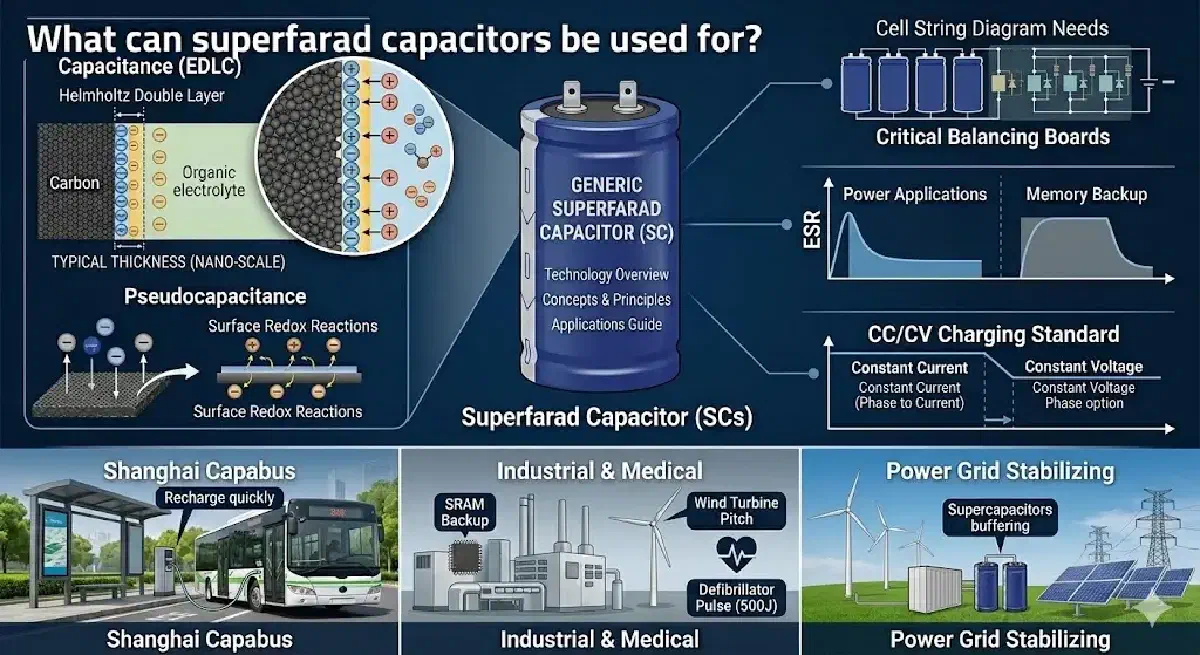
- Electric Double-Layer Capacitance (EDLC): Energy is stored electrostatically by the separation of charge in a Helmholtz double layer. This layer is incredibly thin—typically \(0.3\) to \(0.8\) nm. Because no chemical bonds are broken, EDLCs can withstand hundreds of thousands to millions of cycles.
- Pseudocapacitance: This involves fast, reversible Faradaic redox reactions on the electrode surface. Using transition metal oxides (like \(RuO_2\)) or conducting polymers, it offers up to 10 times higher capacitance than pure EDLC.
- Hybrid & Asymmetric Capacitors: Systems like Lithium-ion capacitors combine an EDLC-type electrode with a battery-type electrode to achieve higher energy densities.
2. The Internal Resistance (ESR) Metric#
A common technical inquiry is whether an internal resistance (ESR) of “0.5” is acceptable. The answer depends entirely on the unit scale and application:
| Application Type | Capacity Range | Standard ESR Range | Status of “0.5” |
|---|---|---|---|
| Power Applications | 100F — 10,000F | < 1 mΩ | Excellent (if 0.5 mΩ) |
| Memory Backup | 0.1F — 470F | 15Ω — 100Ω | Normal (if 0.5 Ω) |
Wear-Out Standard: According to IEC/EN 62391-2, a component reaches end-of-life when its capacitance drops by >30% or its ESR exceeds 4x its initial datasheet specification.
3. Charging Mastery: The CC/CV Standard#
Supercapacitors have extremely low internal resistance, meaning they can draw massive inrush currents if connected directly to a voltage source.
Professional Charging Workflow:#
- CC Phase (Constant Current): Limit the current to protect the power supply and prevent overheating.
- CV Phase (Constant Voltage): Once the Rated Voltage (\(U_R\)) is reached, hold it steady as the current naturally tapers off.
Critical Safety Warning: Never exceed the rated voltage (typically 2.1V to 3.0V), as this triggers electrolyte decomposition, leading to gas formation or short circuits.
4. The Critical Role of Balancing Boards#
When supercapacitors are connected in series to reach higher system voltages, a balancing board is mandatory.
- Why Balancing? Minor manufacturing variances in leakage current and capacitance mean that individual cells in a string may reach an overvoltage state while others remain undercharged.
- Passive Balancing: Uses parallel resistors to bleed off excess charge.
- Active Balancing: Employs electronic management to transfer energy between cells, offering superior efficiency.
5. Real-World Applications#
So, what are supercapacitors used for? They excel in environments requiring high power density and extreme cycle life:
- Transportation: Powering regenerative braking in electric buses and trains. In Shanghai, “capabuses” recharge in minutes at terminal stops. See how supercapacitors solve cold-weather engine starting for heavy-duty trucks.
- Power Grid: Voltage stabilization and grid buffering for renewable energy sources like wind and solar. Explore supercapacitor solutions for smart grid stability.
- Industrial & Medical:
- SRAM Backup: Ensuring data integrity during power loss.
- Wind Turbines: Powering pitch control systems.
- Defibrillators: Delivering the high-energy pulse required for life-saving shocks.
- Consumer Tech: Quick-charge tools, such as cordless screwdrivers that reach full charge in under 90 seconds.
Summary#
Supercapacitors are a complementary technology to batteries. By respecting voltage limits and utilizing proper active balancing, you can leverage their superior lifespan for the most demanding electrical engineering challenges.