
Most explanations of audio capacitors start from the wrong premise. They say a car runs on DC and a home runs on AC, therefore the two systems need different parts. That is true as far as it goes, and it explains almost nothing about what a capacitor does for an amplifier.
The real difference is the source. Both amplifiers want the same thing at their supply rails: a DC voltage that does not move when the music does. What separates them is how fast that DC can be topped up, and how much impedance stands in the way.
Why “AC versus DC” is the wrong frame#
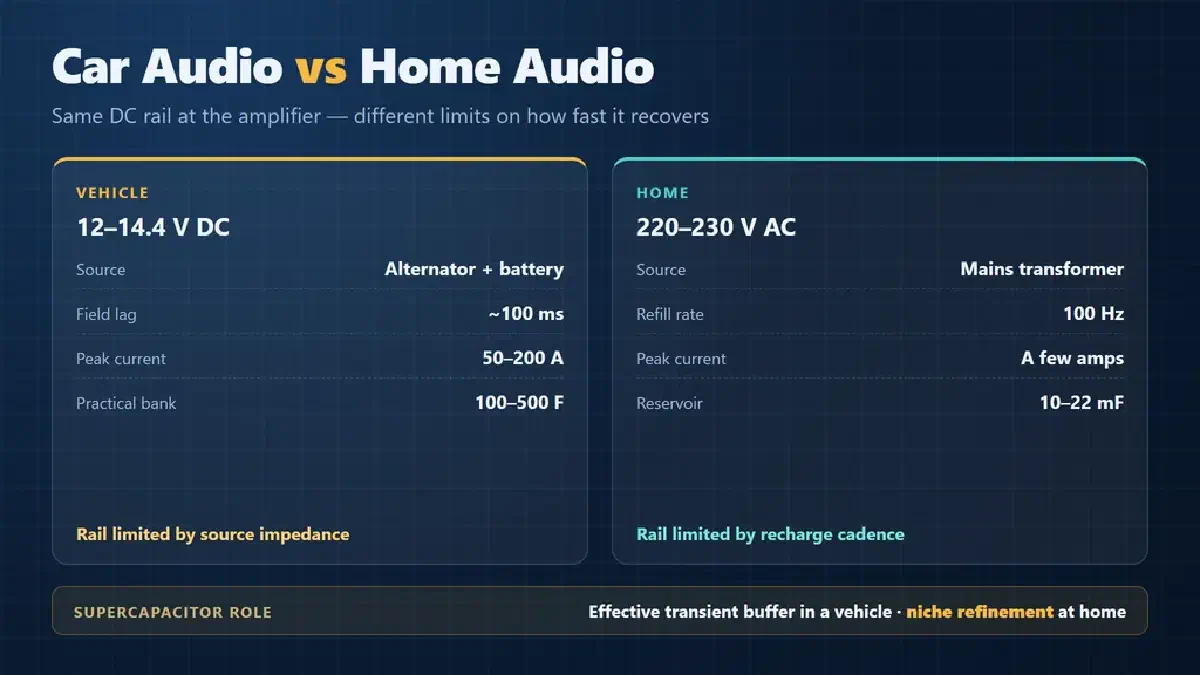
A home amplifier takes 220–230 V AC from the wall, steps it down with a transformer, rectifies it, and smooths the result with a large reservoir capacitor. A car amplifier takes 12–14.4 V DC from the battery and alternator, and in most designs steps it up with a switching converter before the output stage sees it.
By the time current reaches the output transistors, both systems run on DC, and the capacitor sits on a DC rail. The question is not “AC or DC” but what limits how quickly that rail recovers after a transient.
Home audio: a recharge cadence problem#
After full-wave rectification, a 50 Hz supply produces ripple at 100 Hz — 120 Hz on 60 Hz grids. The reservoir capacitor therefore refills 100 to 120 times per second, roughly once every 8 to 10 ms. Between refills, the amplifier runs on stored charge alone.
That is normally fine. A 100–200 W home amplifier might use 10,000–22,000 µF on rails of about ±50 V. Take 20,000 µF, 4 A of rail current, and a 10 ms gap:
$$\Delta V = \frac{I \cdot \Delta t}{C} = \frac{4 \times 0.01}{0.02} = 2\text{ V}$$Two volts on a 50 V rail is about 4 %. The supply is not collapsing; it is breathing slightly. This is why the “home systems need supercapacitors too” argument is weaker than it first appears — the reservoir already does a competent job.
Where home systems genuinely fall short is elsewhere: cheap amplifiers with undersized transformers, long internal wiring, high-impedance ground returns. A supercapacitor fixes none of those. There is a practical barrier too: a high-power home amplifier runs at ±50 V to ±70 V, so a 2.7 V cell would need a long series string plus balancing, and the cost, volume, and leakage are hard to justify when electrolytics already hold the rail within a few percent.
Where supercapacitors do earn a place at home is low-voltage DC gear: headphone amplifiers, DACs, portable players. There a bank can replace or supplement a battery, giving a low-impedance source that does not age like a cell. That is a real application — but a different problem from the one a 200 W power amplifier has.
Car audio: a source impedance problem#
Now change the source. In a vehicle the rail is nominally 12 V and sits near 14.4 V while charging. Peak demand from a large subwoofer amplifier is not 4 A; it is 50 A, 100 A, sometimes several hundred amps for a few milliseconds.
Two mechanisms limit how that current arrives.
The battery has internal resistance. At 100 A, 10 mΩ of internal resistance costs 1 V before anything else happens:
$$\Delta V = I \cdot R_{\text{internal}} = 100 \times 0.01 = 1\text{ V}$$That is most of the way from 14.4 V to 13.4 V, in a system where a one-volt dip is audible and visible in the headlights.
The alternator cannot respond on that timescale. Field current in a Lundell alternator changes with the L/R time constant of the field winding. Work from MIT puts this “on the order of 100 ms or more” and notes that it “dominates the transient performance of the alternator”. A bass note lasting 20 ms is over long before the alternator has adjusted.
So the two sources are slow for different reasons: the battery is limited by resistance, the alternator by magnetic inertia. Both leave a gap that a capacitor mounted next to the amplifier can fill.
Side-by-side#
| Home audio | Car audio | |
|---|---|---|
| Source | 220–230 V AC, 50/60 Hz mains | 12–14.4 V DC, alternator + battery |
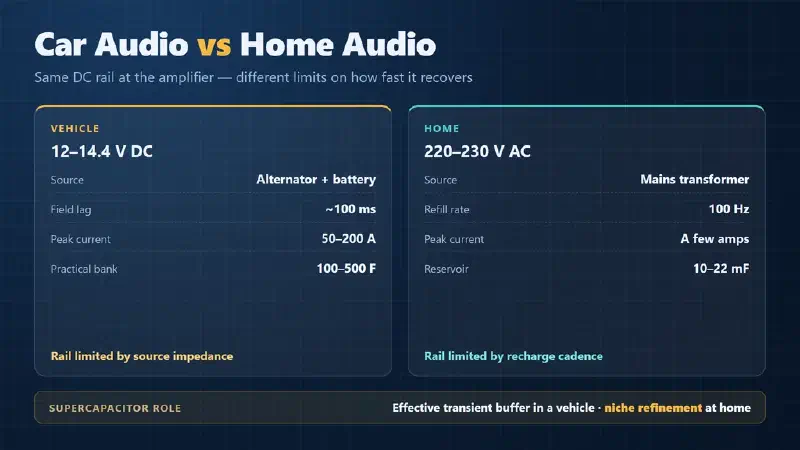
| What limits the rail | Recharge cadence, 100/120 Hz | Source impedance plus field inertia |
| Peak rail current | Single digits to low tens of amps | 50–200 A or more |
| Typical reservoir | 10,000–22,000 µF at ±50 V | 100–500 F module at 14 V |
| Supercapacitor role | Optional refinement in low-voltage DC gear | Effective transient buffer |
| Sizing starting point | 0.5–5 F, small DC devices | 100–500 F module |
How much capacitance actually helps#
Required capacitance follows from how long the transient lasts, using the same relation that sizes any reservoir:
$$C \approx \frac{I \cdot \Delta t}{\Delta V}$$For a 100 A peak and a 1 V allowable droop:
| Transient duration | Capacitance needed |
|---|---|
| 5 ms | 0.5 F |
| 10 ms | 1 F |
| 50 ms | 5 F |
| 100 ms | 10 F |
| 500 ms | 50 F |
This explains a persistent confusion in the market. The “3–5 F, or 10 F for a big system” advice that circulates online belongs to the era of electrolytic stiffening capacitors. Those parts are 1–5 F electrolytics, and they cover only the first few milliseconds of a 100 A event.
A real bass line is not a 5 ms click. At 50 Hz one cycle is 20 ms, and a decaying note with its envelope runs 100–300 ms. Covering that at 100 A needs tens of farads, which is why practical banks are built from 2.7 V cells in series: six 3,000 F cells give a 500 F, 16 V module with ESR around 2 mΩ and a continuous rating near 100 A.
ESR adds a second penalty that capacitance cannot remove:
$$\Delta V_{\text{ESR}} = I_{\text{peak}} \cdot ESR$$At 100 A, 2 mΩ costs 0.2 V instantly, before any charge is delivered. This is why a 500 F module at 2 mΩ outperforms a larger bank at 20 mΩ on short pulses, and why datasheet ESR matters as much as the farad rating.
What a supercapacitor cannot do#
Clear limits are what separate a specification from a sales claim.
- It does not generate power. It buffers; it does not create energy. If the charging system cannot supply the average load, a capacitor only postpones the problem.
- It is not a battery replacement. A 500 F module at 16 V stores about 17 Wh; a 50 Ah battery stores roughly 600 Wh.
- It self-discharges. A bank left connected will slowly pull the battery down, so vehicles parked for weeks need an isolator.
- It needs charge-current limiting and cell balancing. An empty bank looks close to a short circuit to the alternator, and any series string needs voltage management.
These are not reasons to avoid supercapacitors; they are the conditions under which the part performs as specified. We cover them in our car supercapacitor installation and safety guide, including inrush limiting, derating, and cable sizing.
Which scenario should you design for?#
If you build or specify amplifiers, the practical reading is straightforward.
Car audio is the primary market. Every constraint that makes a supercapacitor useful — high peak current, long cable runs from a front-mounted battery, a source with real impedance and mechanical inertia — is present in a vehicle and largely absent in a living room.
Portable and vehicle-mounted PA is second. Small generators and inverter supplies have their own regulation limits, and a buffer on the DC side stabilises the rail the same way. The mechanism is identical; only the numbers change.
Home audio is a niche — a real one, served by low-voltage DC designs, but not the headline. Claiming supercapacitors are essential for home amplifiers invites a technical objection you cannot answer.
For the sizing math behind a specific build, our guide to sizing a capacitor for car audio walks through the estimate from amplifier power. If you are still deciding where the energy storage belongs, supercapacitor principles, ESR, and charging covers the underlying behaviour. Background on the technology is available from Wikipedia on supercapacitors, and the alternator transient behaviour cited above comes from the MIT paper A New Design for Automotive Alternators.
Frequently asked questions#
Why do car audio systems need supercapacitors but home systems usually do not?#
Because the source is weaker relative to the load. A car amplifier draws hundreds of amps from a 12 V system whose alternator needs roughly 100 ms to change its output. A home amplifier draws a few amps from a mains supply refilled 100 or 120 times per second through a transformer.
Can I use a car audio supercapacitor module on a home amplifier?#
Not directly. A 16 V module is built for a 14 V rail. A ±50 V home rail would need roughly 40 cells in series plus balancing, and the leakage and volume penalties rarely justify it.
How many farads does a car audio system need?#
Size from the transient, not from a rule of thumb. Use the relation above with your peak current, the duration of a bass note, and the droop you can accept. For 100 A and 100 ms at 1 V that is 10 F; real builds use 100–500 F for margin and repeatable performance.
Does a larger capacitor make home audio sound worse?#
There is no accepted engineering mechanism for that. Very large banks bring practical costs — inrush current, leakage, size — but “muddy bass from too much capacitance” is an audiophile claim, not a measured effect. Treat it as an opinion, not a specification.
Summary#
The difference between car audio and home audio is not AC versus DC. It is what limits the supply rail: a 100 Hz recharge cadence at home, and source impedance plus roughly 100 ms of alternator inertia in a vehicle. That is why a supercapacitor is routine in a high-power car build and a niche refinement at home, and why the farad numbers circulating online are usually a generation out of date.
If you are specifying a module for an audio build, send us your load profile and we will help match capacitance, ESR, and voltage to the transient you actually need. You can also compare modules on our supercapacitor product pages, such as the Maxwell 16V 500F module.