
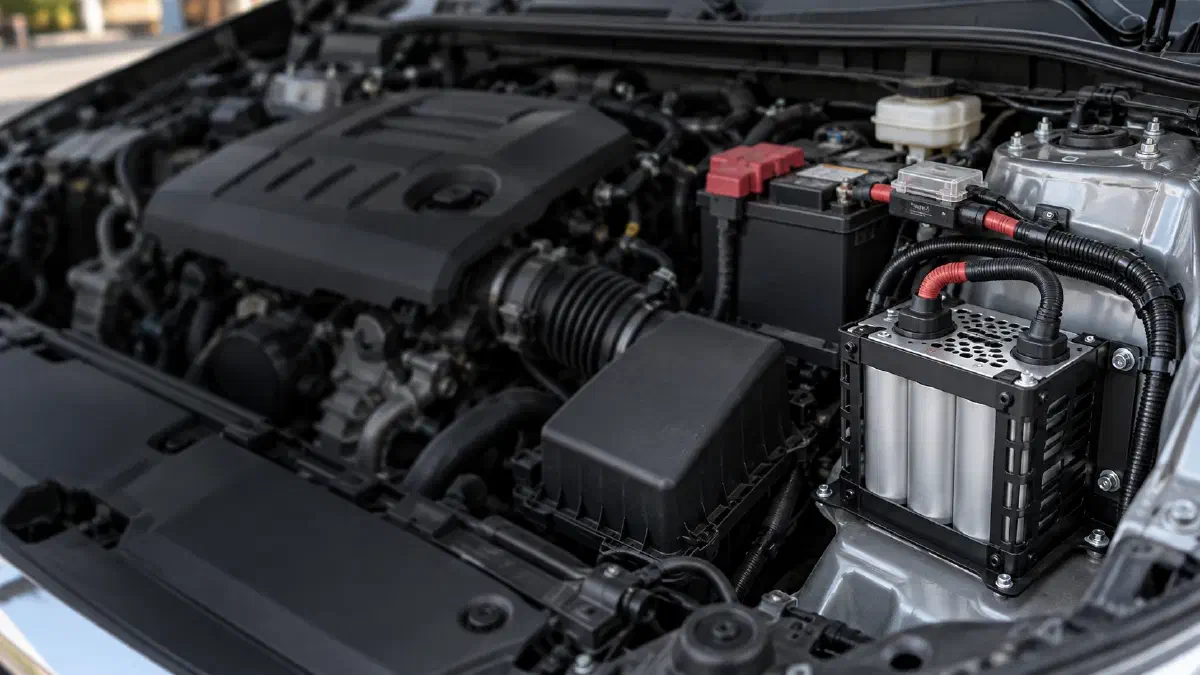
Yes — a supercapacitor is safe to install in a car, provided the installation handles three things: inrush current, heat, and over-voltage. It does not have a lithium-style thermal-runaway chain reaction, and in the abuse tests published for the acetonitrile cells cited below, nail penetration and a terminal short produced no fire or explosion. Those results are specific to the tested products and conditions — not a universal guarantee for every cell design or installation — but the real risks on a vehicle are not explosion, and all of them have well-established engineering fixes.
If you are building a car audio system, adding a start-assist module, or supplementing a lead-acid battery with a capacitor bank, “is it safe?” is the right first question. The honest answer is a qualified yes. A supercapacitor will not enter thermal runaway the way a lithium cell can, but an installation that ignores charge-current limiting or thermal derating can still damage the charging system, cook the cells, or weld a dropped wrench to a terminal. This guide covers what actually matters — and corrects a few pieces of popular advice that are simply wrong.
A bank is not a like-for-like battery replacement. A 16 V / 500 F bank stores on the order of 18 Wh at full charge — less across its usable voltage window — whereas a typical lead-acid starter battery stores several hundred watt-hours. A supercapacitor bank is used for high pulse power: starting assist and load levelling, not to replace the battery’s energy. If replacing the battery is the goal, the energy budget, parked time, DC/DC conversion, low-temperature behaviour, and fault protection each need their own design.
Why Supercapacitors Are Inherently Safer Than Batteries#
The safety case for a supercapacitor does not rest on a vent or a relief valve. It rests on the chemistry and the physics:
- There is no oxygen-carrying positive electrode. An EDLC stores charge in a double layer on activated carbon, rather than releasing energy through a redox reaction in a metal-oxide cathode.
- There is no chain reaction to run away. An EDLC carries far less energy per unit mass or volume than a lithium-ion cell, and any local failure stays local rather than propagating through the pack.
- In the published abuse testing, the observed failure mode was open circuit, not fire. The results below are specific to the acetonitrile products and conditions tested by KYOCERA AVX in Safety Considerations for Acetonitrile SuperCapacitors:
| Abuse test (fully charged cell) | Published result |
|---|---|
| Nail penetration | Voltage falls to 0 V; cell fails open-circuit, no fire, no explosion |
| Terminal short circuit | No swelling, no venting |
The available abuse-test evidence for the cited acetonitrile-based products therefore showed no fire or explosion in those specific tests. That is reassuring, but it should not be treated as a universal guarantee for every supercapacitor design or installation — the manufacturer’s own notice states that typical specifications may not apply to all applications, and abnormal installation conditions sit outside the scope of any single test series. Note also the difference between two certifications that are often confused: UL 810A is the standard for electrochemical capacitors, while UL94 V-0 is a flammability rating for the plastic enclosure material. A housing rating is not a substitute for a product safety certification; a good design can reference both, but they are not interchangeable. For general background on how these devices compare with other capacitor families, see the Wikipedia article on supercapacitors.
The Real Risk: Inrush Current, Not Explosion#
Here is the single most important number in this article. A supercapacitor has extremely low ESR, so an uncharged supercapacitor looks almost like a dead short to whatever is charging it, and the initial current is limited only by the total loop resistance:
$$ I_{inrush} \approx \frac{V_{source}}{ESR_{total}} $$KYOCERA AVX states the problem directly in Charge Control Methods for SuperCapacitors: the charge current “greatly eclipses” what the source can supply. Their published figures for maximum peak charging current make the scale clear:
| Device | Capacitance | Voltage | Peak inrush current |
|---|---|---|---|
| SCC cylindrical cell | 3000 F | 2.7 V | ≈ 2165 A |
| 16 V SCM module | 500 F | 16 V | ≈ 1900 A |
| 48 V SCM module | 165 F | 48 V | ≈ 2165 A |
In other words, a vehicle-scale bank (16 V / 500 F class) can demand roughly 1900 A at the moment of connection — not the 150–200 A often quoted in forum posts. A source asked to deliver that can exceed what the power supply and wiring are designed for: the outcome can range from a transient upset or protection trip to permanent damage to the charging system, and even a partial surge creates voltage transients across sensitive circuits. The manufacturer’s own wording is that the resulting dV/dt “can either create permanent damage or a transient upset” — the surge has to be engineered for, not assumed harmless.
There are two established ways to fix it:
- Passive limiting — a series power resistor or an NTC thermistor. As a reference point, a 10 F capacitor connected directly to a 2.7 V source draws about 27 A; adding a 150 Ω series element drops the initial current to roughly 18 mA.
- Active limiting — a MOSFET load switch or a dedicated constant-current/constant-voltage (CC-CV) charge controller with a programmable input-current limit.
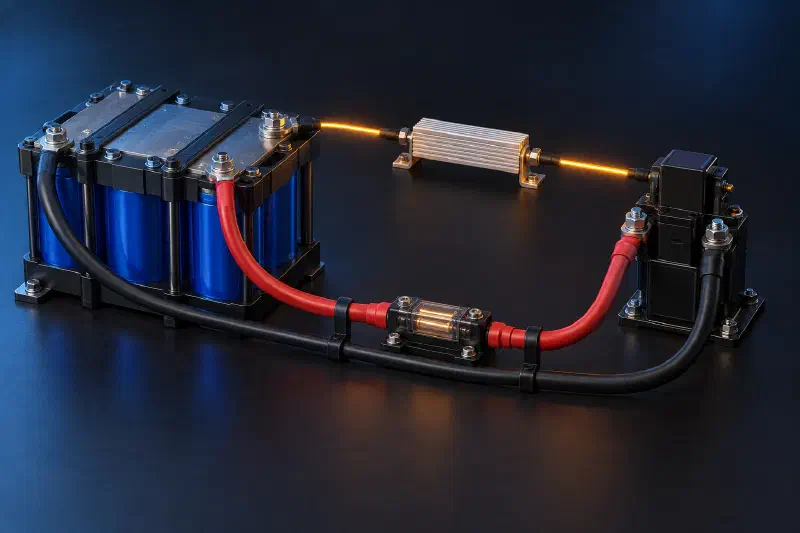
One common misconception deserves to be retired: disconnecting the bank with a relay after startup does not limit inrush. A relay or isolator solves a different problem — preventing the bank from feeding back into the battery when the engine is off. It is a useful part of a design, but it is not a charge-current limiter. For the full charging procedure, see our guide to correct supercapacitor charging, and for a worked treatment of the control problem, see supercapacitor balancing methods: passive vs active.
Heat, Voltage Derating, and Lifetime#
Supercapacitor life is governed by two variables, not one: applied voltage and cell temperature. The relationship is conventionally written as an inverse voltage power law combined with an Arrhenius temperature term:
$$ L \propto V^{-n} \cdot e^{\,Q/kT} $$where \(L\) is expected lifetime, \(V\) the applied voltage, \(T\) the absolute temperature, and \(n\) and \(Q\) device-dependent constants. The practical consequences are easy to remember:
- A small voltage reduction buys a large life increase. KYOCERA AVX reports that on a 2.7 V rated part, derating the working voltage by 0.1 V can extend life by roughly a factor of two; see Charge Control Methods for SuperCapacitors.
- High temperature demands derating, not optimism. In their 85 °C reliability study on a 5 V / 5 F SCM part, the part survived 4,000 hours only after being derated to about 70% of rated voltage — at 80–90% it barely reached the same exposure, and at full rated voltage in that environment it failed catastrophically. See Reliability of SuperCapacitors: Paper 1 for the test data.
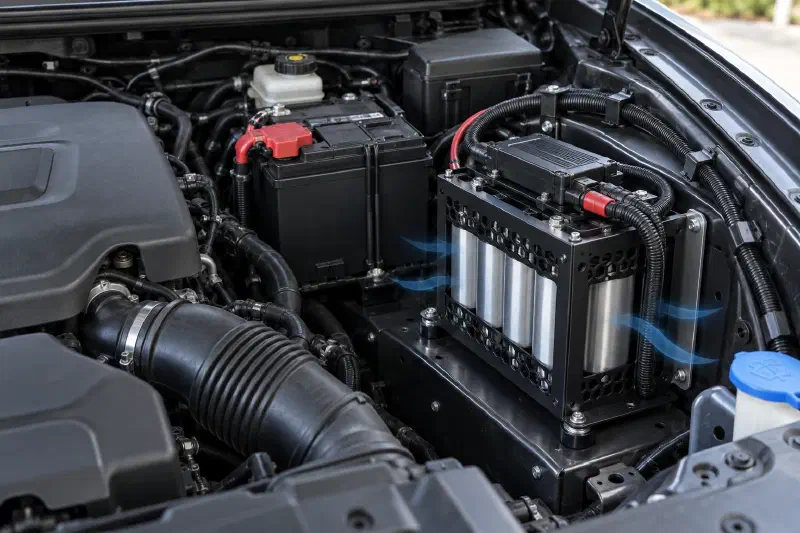
That has a direct design implication for vehicles. Mounting a bank in the engine bay puts it in a hot, vibrating environment, and heat is precisely what consumes lifetime. You have two reasonable options: locate the bank somewhere cooler (under the seat, in the cabin, or in a ventilated area away from exhaust and radiator heat), or derate its working voltage if it must live under the hood.
What you should not do is wrap it in insulation. Advice to bundle a capacitor bank in polyethylene foam, fiberglass mat, or cloth tape is popular online and is wrong on two counts. First, those materials add a flammable layer around an energy-storage device — the opposite of good practice. Second, insulation can only raise the cell temperature, whereas the goal is to remove heat. The correct approach is a flame-retardant (UL94 V-0) mounting bracket with free airflow that does not block the cell’s surface. If you want the deeper background on how ESR and thermal behaviour interact, our technical breakdown of ESR and charging covers it.
Balancing: Why Series Stacks Need Cell Management#
Any time supercapacitors are used in series, voltage imbalance appears during charge and discharge — this is a structural property of series strings, not a quality defect. The requirement is a documented cell-voltage-management strategy; how you implement it depends on the module and the application. Three cell-to-cell differences drive the imbalance:
- Capacitance variation dominates the dynamic drift during fast charge and discharge.
- Leakage current variation dominates the steady-state imbalance during long idle periods — it is the main reason a string slowly diverges even when nothing is happening.
- ESR variation shifts how much ripple and load current each cell sees.
A cell that drifts above its rated voltage ages faster and can eventually fail; the specific failure mode depends on the product and the abuse conditions, and a failure can degrade the whole string. That is why a series string needs a documented management strategy — which may be passive balancing, active balancing, a certified module with integrated balancing, or manufacturer-matched cells operated within their verified limits. It is also why manufacturers match cells on capacitance, leakage current, and ESR together before building a module. Our supercapacitor balancing guide covers the design decisions in full.
Installation Checklist for a 12 V or Car Audio System#
| Item | Recommendation | Why it matters |
|---|---|---|
| Inrush limiting | Series resistor or NTC, or an active CC-CV controller | An uncharged cell is nearly a dead short; the surge is what damages the charging system |
| Fusing | Fuse the positive cable at the battery end | Limits damage from an accidental short of a very low-ESR device |
| Cable gauge | Example: 32 mm² (~2 AWG) baseline; 50 mm² (~1/0 AWG) over ~1.5 m | Voltage drop and cable heating are set by loop resistance at high current |
| Ventilation | Flame-retardant mounts, unobstructed airflow | Lifetime falls as temperature rises; insulation makes this worse |
| Voltage derating | Run below rated voltage, especially in a hot location | A 0.1 V reduction can roughly double lifetime |
| Cell-voltage management | Passive, active, a certified module, or manufacturer-matched cells — whenever cells are in series | Prevents a single cell from being driven over voltage |
| Low-voltage cutoff | Example: switch to battery supply below about 11 V | Keeps the vehicle starting and avoids deep discharge |
| Long-term parking | Isolator or disconnect for a parked vehicle | Self-discharge will otherwise pull the battery down |
| Source & testing | Traceable origin plus recorded pre-shipment test data | Ageing is invisible without measurement |
The cable gauges and the 11 V cutoff above are example design values for a 12 V vehicle, not universal rules. The correct figures depend on continuous and peak current, cable run length, allowable voltage drop, ambient temperature, insulation and fusing — size them for your own vehicle and, where the part is specified, follow the manufacturer’s data.
Sourcing and Testing: What Actually Matters#
The most common piece of advice on this topic — “avoid used supercapacitors” — is the wrong framing. What causes failures is not age by itself; it is untraceable stock that was never tested. Capacity fade, rising ESR, and seal degradation are largely invisible from the outside, which is why the meaningful criterion is:
Traceable origin plus pre-shipment testing — not new versus used.
A genuine brand cell is a sound engineering choice only when it can be shown to meet a documented specification. A single pass/fail check is not a cure for age: storage temperature, over-voltage history, moisture, mechanical damage, and lost batch traceability all leave marks that a quick test may miss. A defensible record covers at least:
- origin, or batch/serial traceability;
- measured capacitance;
- measured ESR;
- leakage current;
- and, where applicable to the product, insulation / withstand testing —
each recorded together with the test method and conditions. A no-name cell of unknown history with no test data is a poor choice, regardless of how new it looks. This is the distinction that separates suppliers who test from sellers who only move boxes, and it is why we publish our quality control process — including how cells are measured before dispatch.
Self-discharge belongs in the same conversation. Published data for acetonitrile-based supercapacitors is quoted over 24 hours, during which a charged cell retains most of its charge even at 85 °C. Extrapolating that into a promise that a bank will still start a car after six months in a garage is not supportable — the real daily voltage drop depends on the leakage current of the specific cells and the bank capacitance, so it should be calculated rather than assumed.
FAQ#
Are supercapacitors safe in a car?#
Yes, provided three things are handled: charge-current limiting, voltage derating, and thermal design. An EDLC supercapacitor stores energy physically on activated carbon and has no lithium-style thermal-runaway chain reaction; in the published abuse tests on the cited acetonitrile cells, nail penetration and a terminal short produced no fire or explosion. An uncharged cell, however, looks almost like a dead short to the alternator, so inrush current must be limited.
Can a supercapacitor explode or catch fire in a car?#
EDLC supercapacitors do not enter lithium-style thermal runaway. In published abuse testing on acetonitrile-based cells, a fully charged cell subjected to nail penetration dropped to 0 V and failed open-circuit, and a terminal short produced no swelling and no venting — with no fire or explosion. These results are specific to the tested products and conditions and are not a universal guarantee for every supercapacitor design or installation. The relevant product safety standard is UL 810A.
Why does my supercapacitor get hot while charging?#
Heat usually comes from the charging path rather than the capacitor. Internal heating follows \(I^2R\) in the ESR and is small in a low-ESR cell, so the dominant sources are inrush current in undersized wiring, a resistor-based limiter dissipating energy, and — most of all — a hot mounting location such as the engine bay. Lifetime is a function of both voltage and temperature.
Do supercapacitors need a balancing board in a car?#
Any series string requires a documented cell-voltage-management strategy — passive balancing, active balancing, a certified module with integrated balancing, or manufacturer-matched cells within their verified limits. Two cells in series are already a string, and imbalance appears whenever capacitance, leakage current, or ESR differ between cells, with leakage current dominating the steady-state case.
Will a supercapacitor drain my car battery when parked?#
A supercapacitor self-discharges faster than a battery, so a bank left permanently connected will slowly pull the battery down. Published self-discharge data is typically quoted over 24 hours; the real daily drop depends on cell leakage current and bank capacitance. For vehicles parked for long periods, fit an isolator.
What cable size does a car supercapacitor need?#
For a 12 V start-assist or car audio bank, a 32 mm² (roughly 2 AWG) positive cable is a common baseline, upgraded toward 50 mm² (about 1/0 AWG) if the run from the battery exceeds about 1.5 m — example values, not universal rules. Cable size depends on your continuous and peak current, run length, allowable voltage drop, ambient temperature, insulation rating, and fusing. At high current, voltage drop is set by cable resistance — which is why undersized cable shows up as hard cold starts and dimming headlights.
References#
- KYOCERA AVX, Safety Considerations for Acetonitrile SuperCapacitors. Source
- KYOCERA AVX, Charge Control Methods for SuperCapacitors. Source
- KYOCERA AVX, Reliability of SuperCapacitors: Paper 1 — Unique Performance at 85 °C & Self-Balancing. Source
- Wikipedia, Supercapacitor. Source
Conclusion#
A supercapacitor is safe in a car, but “safe” is a property of the installation, not of the component alone. Handle inrush current with a proper charge-current limiter, keep the cells cool, derate the working voltage, manage the voltage of any series string, and source parts that come with a traceable origin and recorded test data. Do those five things and the main risk left is one that batteries solve less well every year: the lead-acid pack being asked to do work it was never designed for.
If you are sizing a bank for a car audio build, a start-assist module, or a 12 V backup, explore our supercapacitor product series or contact our team with your vehicle voltage, load current, and the run length from the battery — we will help you specify the right cells, cables, and protection. For a related vehicle application, see how supercapacitors handle cold-weather truck start-stop duty, and for audio-specific sizing math read our capacitor for car audio guide.