
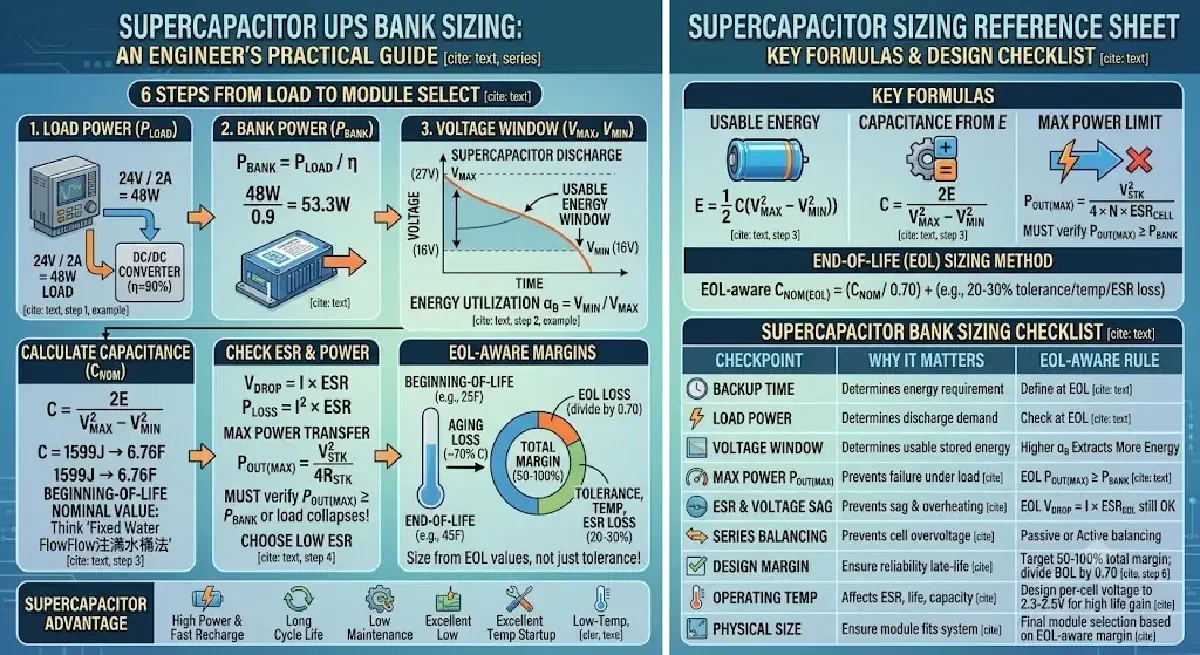
A supercapacitor bank is a good UPS backup solution when your system needs seconds or minutes of ride-through power, fast recharge, long cycle life, and low maintenance. It is usually not the right choice for hours of backup time.
For industrial electronics, telecom controllers, smart meters, PLC systems, medical equipment, and embedded computers, a short power interruption can be enough to corrupt data, interrupt communication, or shut down a control process. In these cases, a supercapacitor bank can bridge the gap between input power loss and system shutdown, battery takeover, or generator start.
This guide explains how to size a supercapacitor bank for UPS backup using practical engineering steps.
When Supercapacitors Make Sense for UPS Backup#
Supercapacitors are strongest in short-duration backup applications. They are not a direct replacement for every UPS battery, but they are excellent when the backup time is short and cycling is frequent.
| UPS Requirement | Supercapacitor Bank Fit | Reason |
|---|---|---|
| Backup for 1-60 seconds | Excellent | High power and fast response |
| Backup for 1-10 minutes | Possible | Depends on load power and module size |
| Backup for several hours | Poor | Battery energy density is much higher |
| Frequent charge/discharge events | Excellent | Very high cycle life |
| Low-temperature startup | Strong | Better peak power than many batteries |
| Maintenance-free industrial system | Strong | No regular battery replacement in many designs |
If your project needs long-duration energy storage, a battery or hybrid system may be better. For broader comparison, see Supercapacitors vs. Batteries.
Step 1: Define the Load Power#
Start with the real load power, not only the nominal system voltage.
You need:
- Load voltage: \(V_{load}\)
- Load current: \(I_{load}\)
- Load power: \(P_{load}\)
- Required backup time: \(t\)
- DC/DC converter efficiency: \(\eta\)
If the load current is known:
$$ P_{load} = V_{load} \times I_{load} $$If the system uses a DC/DC converter, the supercapacitor bank must supply more power than the load receives:
$$ P_{bank} = \frac{P_{load}}{\eta} $$For example, if a 24V controller consumes 2A, the load power is:
$$ 24V \times 2A = 48W $$With a 90% efficient converter:
$$ P_{bank} = \frac{48W}{0.9} = 53.3W $$Step 2: Choose the Usable Voltage Range#
A supercapacitor does not provide constant voltage. Its voltage drops during discharge. This is why you must define the usable voltage range:
- \(V_{max}\): maximum charged voltage of the bank
- \(V_{min}\): minimum voltage the converter can still use
The wider this voltage window, the more stored energy you can use.
For example, a 24V UPS backup design might use:
- \(V_{max} = 27V\)
- \(V_{min} = 16V\)
The DC/DC converter must be able to operate across this full input range.
Voltage utilization. The ratio \(\alpha_B = V_{min} / V_{max}\) tells you what fraction of the bank’s stored energy is actually usable. A wider window (higher \(\alpha_B\)) extracts more energy from the same capacitance. Well-designed banks target \(\alpha_B = 80\text{-}90\%\); if your converter cannot accept such a low \(V_{min}\), consider a wider-input DC/DC so you do not waste stored energy. Our 24V example uses \(16V / 27V \approx 0.59\), which is lower because the converter has a minimum input limit. That is realistic, but it means you need more capacitance to deliver the same energy than a bank with \(\alpha_B = 0.85\) would.
Step 3: Calculate the Required Capacitance#
The usable energy in a supercapacitor bank is:
$$ E = \frac{1}{2} C (V_{max}^2 - V_{min}^2) $$Rearranging the formula:
$$ C = \frac{2E}{V_{max}^2 - V_{min}^2} $$Energy required is:
$$ E = P_{bank} \times t $$Example: 24V Controller Backup for 30 Seconds#
Assume:
- Load power: 48W
- Converter efficiency: 90%
- Required backup time: 30 seconds
- Bank voltage range: 27V to 16V
First calculate bank power:
$$ P_{bank} = \frac{48W}{0.9} = 53.3W $$Then calculate energy:
$$ E = 53.3W \times 30s = 1599J $$Now calculate capacitance:
$$ C = \frac{2 \times 1599}{27^2 - 16^2} $$$$ C = \frac{3198}{729 - 256} = \frac{3198}{473} = 6.76F $$This \(6.76F\) is the beginning-of-life nominal value. Do not stop here: at end of life (EOL) a supercapacitor typically retains only about 70% of its initial capacitance, and ESR roughly doubles. To still meet the requirement at EOL, the bank you select must deliver the energy after that loss, so the EOL-required nominal capacitance is roughly \(6.76F \div 0.70 \approx 9.7F\). After adding tolerance, temperature, and ESR-related energy loss, a practical selection is 15-20F at the required bank voltage. See Step 6 for the full EOL-aware margin method.
Step 4: Check ESR and Peak Current#
Capacitance is only part of the design. ESR matters because it causes voltage drop and heat.
The voltage drop from ESR is:
$$ V_{drop} = I \times ESR $$Power loss is:
$$ P_{loss} = I^2 \times ESR $$If ESR is too high, the system may fail even when capacitance looks sufficient. For UPS backup, choose a module with ESR low enough to support the required discharge current without excessive voltage sag.
Maximum deliverable power. ESR also sets a hard ceiling on how much power the bank can actually deliver. At maximum power transfer the load resistance equals the bank’s internal resistance, giving:
$$ P_{out(max)} = \frac{V_{STK}^2}{4\,R_{STK}} $$where \(V_{STK}\) is the bank voltage and \(R_{STK} = N \times ESR_{cell}\) is the total series resistance of the stack. If \(P_{out(max)}\) is below \(P_{bank} = P_{load}/\eta\), the bank cannot sustain the load no matter how large \(C\) is — the voltage collapses before the energy is used. Always verify \(P_{out(max)} \ge P_{bank}\) before finalizing the design, not just the voltage window and capacitance.
For more detail, read our guide to supercapacitor principles, ESR, and charging.
Step 5: Account for Series Connection and Balancing#
Single supercapacitor cells are typically rated at a nominal 2.7V. For longer service life, design the maximum per-cell voltage to about 2.3-2.5V instead of the full 2.7V rating. This trades a small amount of usable energy for a large lifetime gain — for example, operating at 2.5V and 45°C can reach roughly 10 years, whereas 2.7V at 65°C may last only thousands of hours. Higher-voltage UPS backup systems that need the full 2.7V per cell should plan for more frequent replacement or tighter thermal control.
When cells are connected in series:
- Total voltage increases.
- Total capacitance decreases.
- Cell balancing becomes necessary.
- Overvoltage protection becomes critical.
For \(N\) identical capacitors in series:
$$ C_{total} = \frac{C_{cell}}{N} $$This means ten 100F cells in series become a 10F bank, not a 100F bank.
To prevent individual cells from exceeding their voltage rating, use passive or active balancing. See our supercapacitor balancing guide before designing a series-connected bank.
Step 6: Add Design Margin (EOL-Aware)#
Do not size a supercapacitor bank exactly to the calculated minimum. Real systems need margin, and the margin must account for end-of-life (EOL) behavior, not just initial tolerance.
Add margin for:
- Capacitance tolerance
- Aging and end-of-life capacitance loss
- Low-temperature performance
- ESR increase over time
- Converter startup requirements
- Leakage current
- Safety derating below maximum voltage
Why a simple “30-50% margin” is not enough. A common quick rule is to add 30-50% capacitance margin. That rule is not EOL-aware. At EOL, capacitance typically falls to about 70% of initial and ESR roughly doubles to about 200% of initial. A 30% capacitance margin is actually smaller than the capacitance loss from aging alone, before you even count tolerance and temperature. Designs sized on that bare rule will underperform late in life.
Recommended EOL-aware method:
- Start from the beginning-of-life nominal capacitance (Step 3).
- Divide by 0.70 to cover the EOL capacitance loss.
- Add a further safety margin (e.g., 20-30%) for tolerance, temperature, and ESR-related energy loss.
- Separately confirm the EOL ESR still satisfies the peak-current and maximum-power-transfer limits from Step 4.
Worked reference. A 36W / 4s backup requirement calculates to about 25F at beginning of life, but an EOL-aware design needs about 45F — roughly 80% total margin. For most industrial designs where reliability matters, we recommend targeting a 50-100% total margin rather than the bare 30-50% initial figure. This protects both stored energy (capacitance margin) and deliverable power (ESR margin).
Supercapacitor Bank Sizing Checklist#
Before selecting a module, confirm:
| Checkpoint | Why It Matters |
|---|---|
| Required backup time | Determines energy requirement |
| Load power | Determines discharge demand |
| Usable voltage range | Determines usable stored energy |
| Voltage utilization \(\alpha_B\) | Higher \(\alpha_B\) extracts more usable energy |
| Converter input range | Must support falling capacitor voltage |
| ESR and current rating | Prevents voltage sag and overheating |
| Maximum power transfer | \(P_{out(max)} \ge P_{bank}\) or load cannot be sustained |
| Series cell balancing | Prevents cell overvoltage |
| End-of-life margin | EOL capacitance ~70%, ESR ~200%; size from EOL values |
| Operating temperature | Affects ESR, lifetime, and capacitance |
| Cycle life target | Confirms supercapacitor advantage |
| Physical size | Ensures module fits the system |
| Safety and certifications | Important for industrial deployment |
FAQ#
Can a supercapacitor replace a UPS battery?#
Yes, if the required backup time is short, usually seconds to minutes. For long backup time, batteries are usually more practical.
How long can a supercapacitor UPS run?#
Runtime depends on load power, capacitance, voltage range, ESR, and converter efficiency. Small systems may run for seconds, while larger banks may support minutes of backup.
Why use supercapacitors instead of batteries for UPS backup?#
Supercapacitors offer fast charging, very high cycle life, strong peak power, and lower maintenance. They are useful when outages are short or cycling is frequent.
Do supercapacitor banks need balancing?#
Yes. If cells are connected in series, balancing is required to prevent individual cell overvoltage and improve service life.
What is the biggest disadvantage of supercapacitor UPS backup?#
Energy density. A supercapacitor bank is usually larger and more expensive than a battery for the same long-duration backup time.
How much does supercapacitor capacitance drop over its lifetime?#
At end of life a supercapacitor typically retains about 70% of its initial capacitance while ESR roughly doubles to about 200%. Size the bank from EOL values (divide the beginning-of-life capacitance by 0.70, then add safety margin), not from initial values, so it still meets the requirement late in life.
Conclusion#
To size a supercapacitor bank for UPS backup, start with load power and required runtime, define the usable voltage range (and its utilization \(\alpha_B\)), calculate capacitance from stored energy, then check ESR, peak current, and the maximum power transfer limit \(P_{out(max)} = V_{STK}^2 / (4 R_{STK})\). Size the margin from end-of-life values — about 70% capacitance and 200% ESR at EOL — rather than the bare 30-50% initial figure.
Supercapacitors are best for short ride-through backup, frequent cycling, harsh environments, and maintenance-sensitive industrial systems. For long outages, batteries or hybrid designs are usually better.
If you need help choosing a supercapacitor cell or module for a backup power project, explore our supercapacitor product series or contact our team with your voltage, load current, and backup time requirements.