
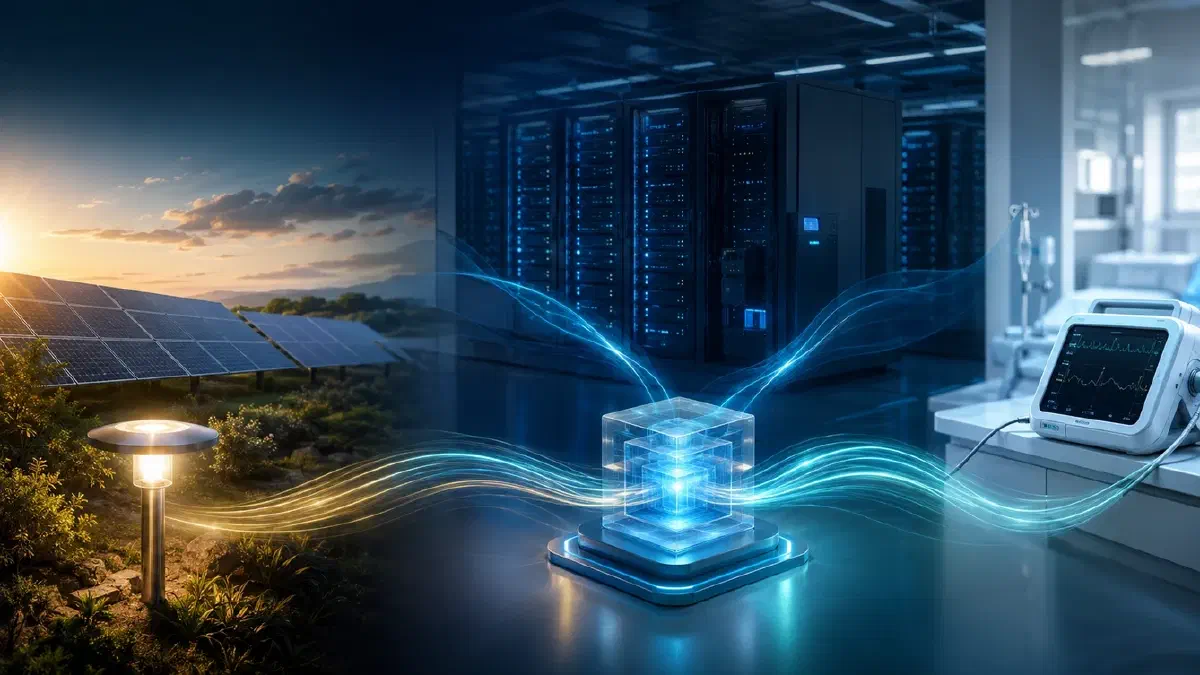
A lithium-ion capacitor (LIC) — also called a hybrid supercapacitor — is an energy storage cell that combines the fast charging and high power density of a supercapacitor with the higher energy density of a lithium-ion battery. A 3.8V 200F cylindrical LIC is a practical choice when your solar, UPS, or medical design needs quick bursts of power, tens of thousands of charge cycles, and maintenance-free operation.
If you design solar lighting, UPS bridge power, or portable medical devices, you have probably felt the trade-off: batteries store plenty of energy but charge slowly and wear out after a few thousand cycles; supercapacitors charge in seconds and last almost forever, but their 2.5V cells do not store enough energy per unit volume. The 3.8V 200F lithium-ion capacitor sits between the two, and for short backup and high-cycle applications it often wins on total cost of ownership.
What Is a Lithium-Ion Capacitor (LIC)?#
A lithium-ion capacitor is an asymmetric energy storage device. Its positive electrode is activated carbon (the same double-layer mechanism used in EDLC supercapacitors), while its negative electrode is a carbon material that has been pre-doped with lithium ions — the same intercalation mechanism used in lithium-ion batteries.
The lithium pre-doping step lowers the potential of the negative electrode, which lets the cell operate at a much higher voltage than a conventional EDLC. That single change delivers most of the LIC’s advantage: a typical EDLC is limited to about 2.5–2.7V per cell, while a lithium-ion capacitor runs at 3.8–4.0V per cell. Because stored energy scales with the square of voltage, the same physical cell stores roughly 4.6 times more energy than an equivalent EDLC (based on Musashi Energy Solutions hybrid capacitor data). For a broader background on capacitor families, see Supercapacitors vs. Batteries and the Wikipedia supercapacitor article.
Lithium-Ion Capacitor vs. Supercapacitor vs. Battery#
The table below compares the three energy storage families using industry data compiled from hybrid supercapacitor references and the EE Power analysis of Abracon’s lithium-ion supercapacitor line:
| Property | EDLC Supercapacitor | LIC / Hybrid (3.8V) | Li-Ion Battery |
|---|---|---|---|
| Cell voltage | 2.5–2.7V | 3.8–4.0V | 3.2–4.2V |
| Specific energy (Wh/kg) | 4–9 | ~37 (up to ~50) | 100–265 |
| Specific power (kW/kg) | 3–10 | 3–14 | 0.3–1.5 |
| Cycle life (thousands) | 100–1,000 | 10–500 | 0.5–10 |
| Charge time | seconds | seconds–minutes | hours |
| Operating range | −40 to +70°C | −20 to +70°C | −20 to +60°C |
| Thermal runaway risk | none | very low | present |
| Self-discharge | days | months | months |
The pattern is clear: the LIC gives up a little energy density versus a battery, but gains 10 to 50 times the cycle life, minutes-scale charging, and much lower safety risk. Compared with an EDLC, it keeps the fast charging and high power, while roughly quadrupling the usable energy per cell.
3.8V 200F Lithium-Ion Capacitor: Key Specifications#
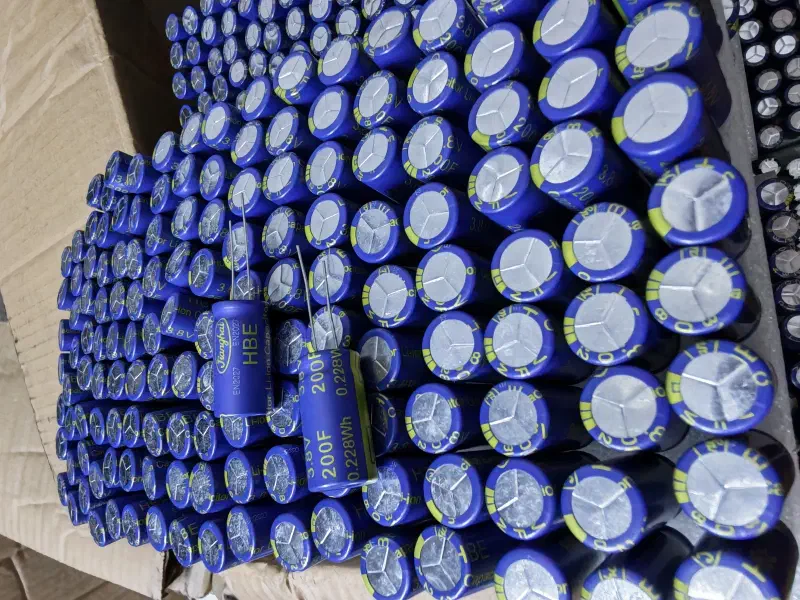
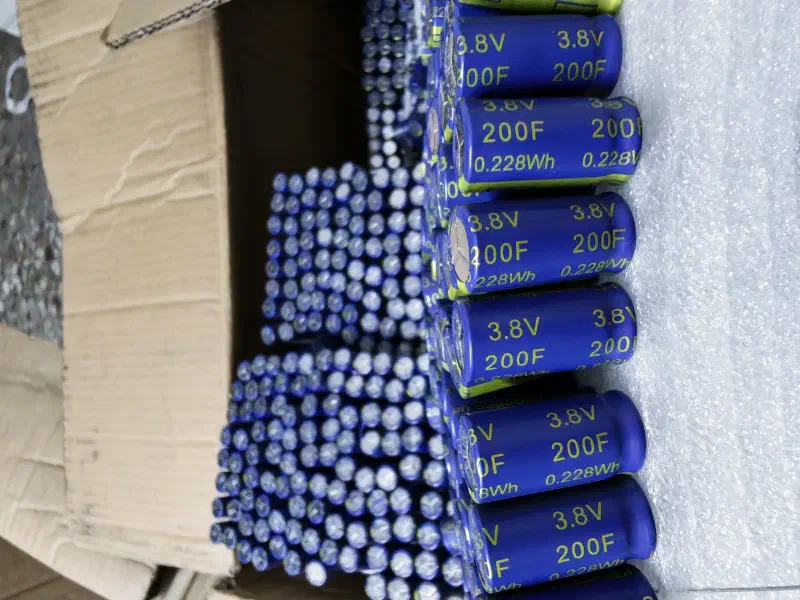
A typical 3.8V 200F cylindrical LIC (radial can, through-hole leads) has these characteristics:
| Parameter | Value |
|---|---|
| Rated voltage | 3.8V |
| Capacitance | 200F |
| Usable voltage window | 2.2V – 3.8V |
| Total stored energy | E = ½CV² = ½ × 200 × 3.8² ≈ 1444 J (0.40 Wh) |
| Usable energy (2.2V → 3.8V) | ½C(V_max² − V_min²) ≈ 960 J (0.27 Wh) |
| Typical cycle life | 10,000 – 500,000 cycles |
| Charge to ~80% | as fast as ~20 seconds (manufacturer data) |
| Peak current capability | up to ~50 × rated capacitance (A) |
| Efficiency | ~90% |
The energy calculation follows the standard capacitor formula:
$$ E = \frac{1}{2} C V^2 $$Because the LIC cannot be fully discharged (the converter needs a minimum input voltage), use the usable-energy form when sizing:
$$ E = \frac{1}{2} C (V_{max}^2 - V_{min}^2) $$For the 200F cell this works out to about 0.27 Wh of usable energy in the 2.2–3.8V window — production cells are labeled 0.228 Wh on the can — roughly equivalent to a much larger EDLC bank, in a single cylindrical package.
High Power Density and Fast Charging#
The two properties engineers care about most in this product class:
- High power density (3–14 kW/kg). The cell accepts and delivers large charge flows, so it can supply strong current bursts and recharge at high current without the capacity fade a battery would show. Abracon’s LIC family, for example, supports peak currents up to 50 times the rated capacitance value.
- Fast charge / discharge. Hybrid supercapacitor data from Musashi shows an LIC can reach about 80% charge in ~20 seconds, and it can be recharged while the system keeps running (online charging). A lithium-ion battery of similar energy takes tens of minutes to hours. This makes the LIC ideal for solar harvesting duty cycles, where the sun is available for only part of the day.
Long Cycle Life and Low Maintenance#
The lithium pre-doping that enables the higher voltage also protects the electrodes: it keeps the positive-electrode potential from rising too high and slows negative-electrode degradation. The practical result is tens of thousands to hundreds of thousands of cycles — one to two orders of magnitude more than a battery — with no thermal runaway risk and no periodic battery replacement in many designs. For maintenance-sensitive systems such as remote solar sites and medical equipment, that translates directly into lower total cost of ownership.
3.8V 200F LIC Applications: Solar, UPS, and Medical#
Solar Energy Storage#
Solar-powered streetlights, IoT sensors, and off-grid controllers have a simple but demanding profile: charge during the day, discharge at night, repeat every day for years. A battery that cycles daily typically lasts only a few years; an LIC bank cycles daily for a decade or more. The fast charge time also means more harvested energy is captured in short daylight windows. This matches the solar-harvesting architecture described in KYOCERA AVX’s technical paper on powering IoT modules from solar panels and supercapacitors.
UPS and Bridge Power#
For UPS ride-through of seconds to minutes — data loggers, PLCs, smart meters, embedded controllers — the 3.8V 200F LIC offers a higher-voltage, higher-energy cell than an EDLC, so fewer cells are needed in series to build the bank. See our step-by-step guide to sizing a supercapacitor bank for UPS backup for the full calculation method; the same formulas apply, with the LIC’s higher voltage reducing the required cell count.
Medical Devices#
Portable defibrillators, electric wheelchairs, and backup supplies in patient monitors need instant power, long standby, and absolute safety. The LIC delivers high peak power on demand, retains charge for months (low self-discharge), and avoids the thermal runaway concern of lithium batteries near patients and oxygen-rich environments. Its maintenance-free operation also suits equipment that is difficult to service frequently.
How to Choose the Right Lithium-Ion Capacitor#
When selecting a 3.8V 200F LIC (or a bank of them), check:
- Voltage rating and derating — run below the rated voltage to extend cycle life (as with all supercapacitors).
- Usable energy — use the \(E = \frac{1}{2}C(V_{max}^2 - V_{min}^2)\) formula, not the full-voltage value, when sizing for a converter with a minimum input voltage.
- ESR and peak current — confirm the module’s ESR supports the discharge current without excessive voltage sag (the maximum deliverable power is \(V^2/4R\)).
- Operating temperature — LICs are rated around −20 to +70°C; derate lifetime at high temperature.
- Series balancing — when cells are connected in series for higher bank voltage, balancing and overvoltage protection are required, exactly as with EDLCs.
We carry a range of supercapacitor products and can help you match a 3.8V 200F lithium-ion capacitor or a multi-cell bank to your voltage, load, and backup-time requirements.
FAQ#
What is a lithium-ion capacitor?#
A lithium-ion capacitor (LIC), also called a hybrid supercapacitor, is an energy storage cell with an activated-carbon positive electrode and a lithium pre-doped carbon negative electrode. It combines the fast charging and high power of a supercapacitor with roughly 4 times the energy density of an EDLC, at a working voltage of 3.8–4.0V per cell.
What is the difference between a lithium-ion capacitor and a supercapacitor?#
A conventional supercapacitor (EDLC) stores charge only on the electrode surfaces and is limited to 2.5–2.7V per cell. A lithium-ion capacitor also stores charge inside the negative electrode through lithium intercalation, which raises the cell voltage to 3.8–4.0V and multiplies usable energy by about 4.6 times for the same size.
Can a lithium-ion capacitor replace a battery?#
For short-duration, high-cycle applications (seconds to minutes of backup, frequent charge/discharge), yes — the LIC outlasts batteries by 10 to 50 times and charges much faster. For hours of continuous energy, batteries still win on energy density.
What is the cycle life of a 3.8V 200F lithium-ion capacitor?#
Typical figures are 10,000 to 500,000 cycles depending on voltage, temperature, and depth of discharge — one to two orders of magnitude more than a lithium-ion battery.
Is a lithium-ion capacitor safe?#
Yes. LIC technology avoids the thermal runaway mechanism of lithium-ion batteries. The electrodes are designed to limit voltage excursions, and the cell operates over a −20 to +70°C window with very low risk of fire or explosion.
How fast does a 3.8V 200F lithium-ion capacitor charge?#
Manufacturer data shows LICs can reach about 80% charge in roughly 20 seconds, and they support online charging while the load keeps running.
Conclusion#
The 3.8V 200F cylindrical lithium-ion capacitor bridges the gap between supercapacitors and batteries: high power density, fast charging in seconds to minutes, cycle life in the hundreds of thousands, and no thermal runaway. It is a strong fit for solar energy harvesting, UPS bridge power, and medical devices that need reliable, maintenance-free backup.
If you are evaluating a lithium-ion capacitor for your project, contact our team with your voltage, load current, and backup time requirements — we will help you size the right cell or module.