
Supercapacitors (also known as ultracapacitors or electrochemical capacitors) are high-efficiency energy storage devices positioned between traditional electrolytic capacitors and rechargeable batteries. They boast extremely high power density and are capable of undergoing hundreds of thousands, or even millions, of charge-discharge cycles.
However, due to their ultra-low Equivalent Series Resistance (ESR) and high sensitivity to voltage, employing the correct charging method is critical for ensuring system safety and maximizing service life. Below are the refined charging steps and technical essentials:
Step 1: Specification Verification and Polarity Identification#
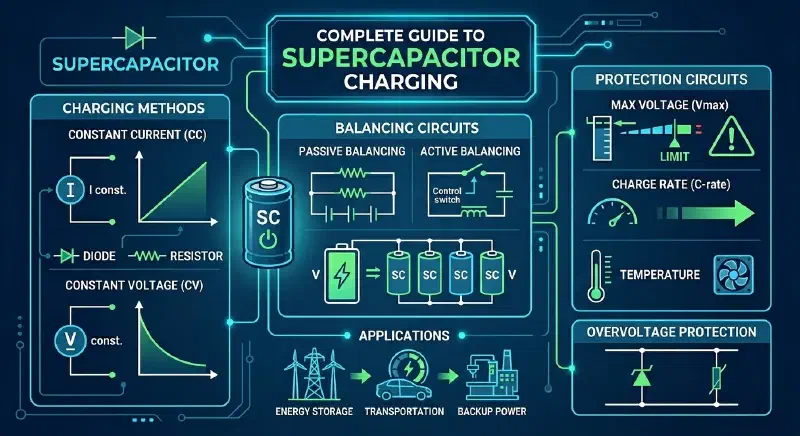
- Strict Voltage Limits: Supercapacitors are low-voltage components. The charging voltage must never exceed the rated voltage ($U_R$). Overvoltage leads to electrolyte decomposition (e.g., the electrolysis of water into hydrogen and oxygen), causing leakage, swelling, or catastrophic short-circuits.
- Polarity Recognition: Although symmetrical Electric Double-Layer Capacitors (EDLCs) theoretically lack physical polarity, manufacturers polarize them during production. It is highly recommended to follow the markings to maintain optimal performance. Hybrid capacitors (such as Lithium-ion supercapacitors) have strict polarity; reversing the connection will cause permanent damage.
Step 2: Utilize a CC/CV (Constant Current / Constant Voltage) Power Supply#
- Managing Inrush Current: Because the ESR of a supercapacitor is extremely low, it behaves like a short circuit at the initial moment of charging, generating a massive Inrush Current.
- Power Supply Protection: You must use a DC power supply with a Constant Current (CC) function. Limit the current within the range allowed by the datasheet to prevent triggering power supply protection or damaging the charging circuitry.
Step 3: Voltage Balancing for Series Modules#
- Equalization Requirement: Since individual cell voltages are low (typically 2.1V–3.0V), high-voltage applications require multiple cells in series. Due to variations in capacitance and leakage current between cells, series charging must include active or passive balancing circuits to prevent individual cells from failing prematurely due to localized overvoltage.
Step 4: Execution and Monitoring#
- Constant Current Phase (CC): Charge at a fixed current; the capacitor voltage will rise linearly during this stage.
- Constant Voltage Phase (CV): Once the voltage reaches the preset rated voltage, transition to CV mode. The current will then drop exponentially.
- Temperature Monitoring: Heat loss during charging is proportional to the square of the current ($P_{loss} = R_i \cdot I^2$). If the casing temperature rises by more than 5–10°C during high-current charging, consider reducing the current to protect the capacitor’s lifespan.
Step 5: Understanding “Voltage Relaxation”#
After disconnecting the power source, you may observe a slight drop in voltage. This is not necessarily a leak; it is a phenomenon known as Voltage Relaxation, caused by charge diffusion within the porous electrodes. The voltage measured after a resting period (e.g., 30 minutes) represents the capacitor’s true stable voltage.
Step 6: Disconnection and Storage Precautions#
- Charging Completion: Charging is generally considered complete when the current drops to approximately 10% of the rated charging current.
- Environmental Constraints: The lifespan of a supercapacitor is highly sensitive to temperature (following the Arrhenius Rule: a 10°C decrease in temperature roughly doubles the lifespan). Store them in a cool, dry place and avoid keeping them at full voltage for extended periods to slow down electrolyte evaporation.