
If you searched for a capacitor for car audio, you are probably dealing with one of three symptoms: headlights dim when the bass hits, amplifier voltage sags during peaks, or your subwoofer sounds less controlled at high volume. A capacitor can help in some systems, but not in every system. In many builds, the real bottleneck is the alternator, battery, wiring, or grounding path.
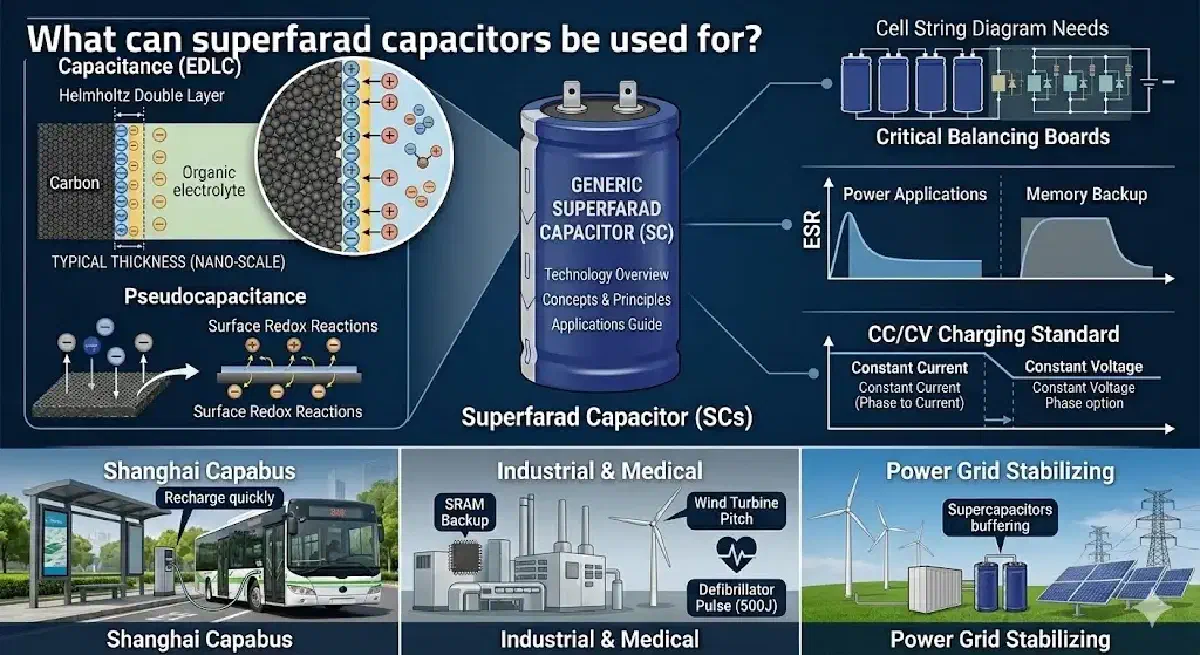
This guide explains what a car audio capacitor actually does, when it is worth installing, how to estimate the right capacitance, and when a supercapacitor module is the better engineering choice. For background on high-power energy storage, see our guide to supercapacitor principles, ESR, and safe charging and our overview of what supercapacitors are used for. If you are comparing brands, you may also want to review our Quality Control process and Technical FAQ.
What does a capacitor do in car audio?#
A conventional car audio capacitor is a short-term energy buffer installed close to the amplifier. Its job is not to replace the battery. Instead, it helps stabilize voltage during very short current bursts, especially when a subwoofer amplifier demands power faster than the cable run and battery can respond.
In simplified terms, the stored energy is:
$$ E = \frac{1}{2} C V^2 $$That means more capacitance and higher system voltage both increase the available burst energy. However, the discharge window in car audio is very short, so the practical value depends heavily on ESR, wiring quality, and amplifier load profile. If you want a deeper look at ESR and pulse performance, read our technical breakdown of ESR and charging.
For general background, external references from Wikipedia on capacitors and Wikipedia on supercapacitors are useful starting points.
When do you actually need a car audio capacitor?#
Not every vehicle with an amplifier needs one. A capacitor usually makes the most sense when:
- The amplifier sees brief peak loads, not long-duration continuous overload.
- The battery and alternator are in good condition, but you still see small voltage dips.
- The capacitor can be mounted very close to the amplifier with short, low-resistance wiring.
- The issue is transient bass impact, not a chronic underpowered charging system.
If your voltage drops hard every time the music gets loud, a capacitor may only mask the symptom. In that case, you may need larger power cable, better grounds, a stronger battery, a higher-output alternator, or a supercapacitor bank. Our article on supercapacitor charging best practices is helpful if you are evaluating fast-response storage for a more advanced build.
Capacitor vs. supercapacitor for sound systems#
The phrase capacitor para sonido is often used loosely across Latin America to mean any add-on energy buffer for car audio, subwoofer, or amplifier performance. In practice, there are important differences between a traditional stiffening capacitor and a supercapacitor module.
| Option | Typical Use | Main Strength | Main Limitation | Best Fit |
|---|---|---|---|---|
| Standard audio capacitor | Short bass transients | Simple and low cost | Limited energy reserve | Small to mid-power systems |
| AGM / upgraded battery | Longer energy support | Better reserve capacity | Slower response than capacitors | Daily-use systems with moderate draw |
| Supercapacitor module | Extreme current bursts | Very low ESR, rapid discharge | Higher cost and system complexity | High-power amplifier racks and demos |
| Alternator upgrade | Continuous power deficit | Fixes root cause | Highest hardware cost | Systems with sustained heavy load |
For applications that need repeated high-current pulses, supercapacitors can outperform conventional capacitors because of their extremely low internal resistance and fast response. Learn more in our guide to supercapacitor balancing boards, which becomes relevant when cells are connected in series. If you want to see real components we supply, visit our Supercapacitors product series to compare models such as Maxwell 2.7V 3000F or LS MTECH 2.7V 3000F.
For additional background on vehicle audio systems, see Wikipedia on car audio.
How to choose the right capacitor size#
The old car-audio rule of thumb is 1 farad per 1,000 watts RMS, but that is only a rough starting point. A more engineering-based estimate is:
$$ C \approx \frac{I \cdot \Delta t}{\Delta V} $$Where:
- \(I\) is the burst current
- \(\Delta t\) is the duration of the burst
- \(\Delta V\) is the maximum voltage drop you can tolerate
Quick example#
If your amplifier demands an extra 80 A for 0.05 s and you want to limit droop to 0.5 V:
$$ C \approx \frac{80 \times 0.05}{0.5} = 8 F $$That number is much higher than what many budget car audio capacitors actually deliver under real ESR conditions, which is why marketing numbers can be misleading.
| System Level | Typical Amplifier Power | Capacitor Guidance | Better Upgrade if Voltage Still Drops |
|---|---|---|---|
| Entry | Up to 800 W RMS | Usually optional | Improve wiring and grounds |
| Mid-power | 800 to 1,500 W RMS | 1F to 3F may help with transients | AGM battery or cable upgrade |
| High-power | 1,500 to 3,000 W RMS | Consider higher-quality capacitor or module | Supercapacitor module |
| Extreme | Above 3,000 W RMS | Standard audio capacitor is rarely enough | Alternator plus supercapacitors |
Installation notes that matter#
A good capacitor installed badly will still perform poorly. Keep these points in mind:
- Mount it close to the amplifier, not near the battery.
- Use short cable runs and the same power/ground gauge as the amplifier feed.
- Charge the capacitor safely before final connection if the manufacturer requires it.
- Protect the circuit with proper fusing.
- Check the ground path first, because bad grounding is a common cause of dimming and noise.
If you move beyond a single capacitor and start using multi-cell modules, voltage management becomes important. Our supercapacitor charging guide and balancing guide explain the next step.
Frequently asked questions#
Does a capacitor make bass hit harder?#
Sometimes it improves transient stability, but it does not create power on its own. If the charging system is undersized, the improvement may be small.
Is a capacitor better than a second battery?#
Not always. A capacitor reacts faster, but a second battery stores much more energy. They solve different problems.
How many farads do I need for a subwoofer?#
For basic systems, many installers start around 1F per 1,000W RMS. For engineering decisions, use the burst-current formula instead of relying only on the rule of thumb.
Is a supercapacitor good for car audio?#
Yes, especially in high-power systems with sharp current peaks. Supercapacitors offer much lower ESR and faster discharge than standard audio capacitors, but they need proper system design.
Summary#
A capacitor for car audio is most useful when your system has short power bursts and the rest of the electrical system is already healthy. If your problem is repeated voltage sag under heavy load, a battery upgrade, alternator upgrade, or supercapacitor module is often the better fix. Choose the solution based on the real cause, not only on the symptom.
If you are planning a build and want help selecting the right energy-storage component, contact our engineering team for a free consultation.